Signs of Mold After a Florida Storm: What Orlando & Tampa Homeowners Need to Know
TL;DR
Mold starts growing within 24 to 48 hours after water gets into your home. After a Florida storm, you might not see it yet, but the smell, the way your HVAC is moving air, the paint on your walls and your own allergy symptoms can all tell you it's already there. Here's what to look for and when to stop trying to handle it yourself.
Why the Clock Starts Immediately
After a storm pushes water into your home, mold doesn't wait for you to find it. In Florida's heat and humidity, mold can begin colonizing a wet surface within 24 to 48 hours. By the time you notice a smell or see discoloration, the growth is already established behind the surface.
According to the EPA's Brief Guide to Mold, Moisture and Your Home, mold growth can begin on wet materials within 24 to 48 hours under the right temperature and humidity conditions — conditions Florida provides year-round. Knowing the signs before they become visible can save you from remediation costs that compound the longer the problem goes unaddressed.
7 Signs of Hidden Mold After Water Damage
1. A Musty Smell That Won't Go Away
A dry house doesn't smell like anything in particular. If you notice a musty or earthy smell that stays after a few days of open windows and fans, moisture is trapped somewhere in the structure. Mold produces microbial volatile organic compounds as it grows, and that smell is a byproduct of active growth. If you can smell it, it's already established.
2. Discoloration Behind Baseboards or Along Wall Seams
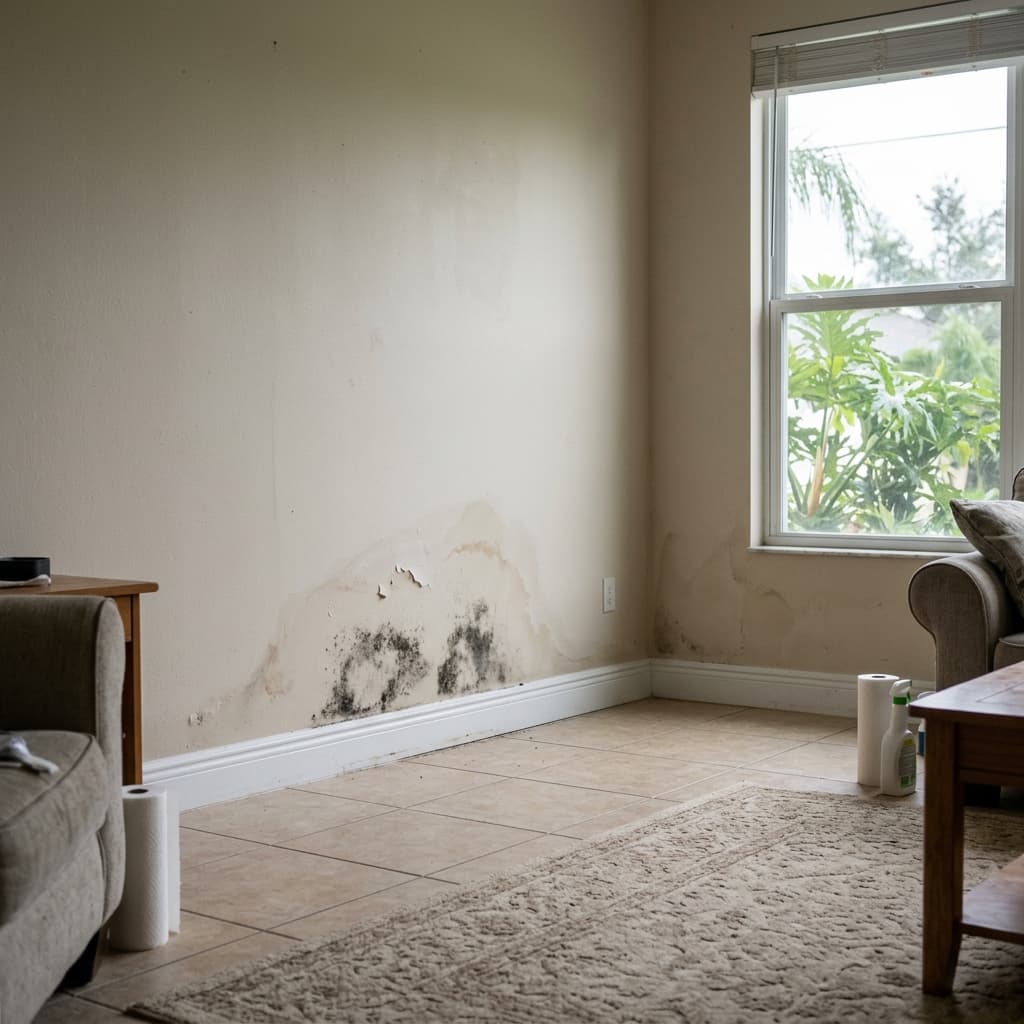
Water that enters through a foundation or seeps behind wall materials typically travels down. The first visible sign is often discoloration near the floor: dark patches along the bottom of drywall, watermarks behind baseboards or staining along the joint where the wall meets the slab. These marks indicate moisture in the wall cavity. In Florida, where there's consistent moisture in a wall cavity, mold follows.
3. Bubbling or Peeling Paint
Paint doesn't bubble on its own. When wall surfaces lose adhesion, moisture is working through from behind. This shows up most on exterior-facing walls after hurricane or tropical storm events. If you see paint lifting anywhere in your home after a storm, treat it as a moisture indicator until you can rule it out.
4. Your HVAC System Blowing Musty Air
Your HVAC system pulls air from throughout the house, conditions it and pushes it through every room. If mold is growing anywhere in your home, the system can pick up spores and circulate them. A musty smell coming from your vents, particularly on first startup, is a sign that either the duct system itself has mold or there's a significant source somewhere in the living space the system is drawing from.
5. Warping or Buckling Flooring
Hardwood and laminate flooring absorb moisture from below when the subfloor or slab gets wet. The planks swell unevenly, causing gaps, ridges or a spongy feel underfoot. Warping flooring after a storm event means the subfloor has been wet long enough to cause damage. Mold growth on the underside of the subfloor is common at this point, even when nothing is visible from above.
6. Visible Growth in Corners or Under Sinks
Some mold is in plain sight if you know where to look. Check corners of bathrooms, around window frames, under sinks and inside lower cabinet spaces. Black, green or white fuzzy growth on any porous surface is active mold. Visible growth after a water event is a symptom of a larger issue. The visible portion is typically a fraction of the total growth behind or beneath the surface.
7. Allergy Symptoms Getting Worse Indoors
If household members experience more nasal congestion, coughing, eye irritation or respiratory symptoms indoors than outdoors, and especially if symptoms improve when leaving the house, that's a health response to airborne particles. Mold spores are among the most common causes of indoor air quality problems. Symptom patterns that concentrate indoors and ease outside point to something in the building environment.
Why Florida Homes Are More Vulnerable
Year-Round Humidity
Florida's outdoor humidity rarely drops below 50%, and during rainy season it consistently runs above 70%. Air conditioning keeps indoor humidity in check as long as the system is working and no new moisture is entering. After a storm that brings water inside or creates conditions for ground moisture to rise, the building envelope is no longer keeping humidity out. Mold thrives at humidity above 60%, and Florida's baseline outdoor humidity gives it everything it needs the moment water intrusion happens.
Older Construction
Homes built before 2000 in Florida often lack the vapor barriers, house wraps and sealed penetrations that newer construction standards require. Windows, doors and foundation joints in older homes have more points of entry for water during high-wind storm events. If your home was built before 2000, a post-storm inspection is worth more than it costs if it catches growth early.
Slab Foundations
Most Florida homes sit on a concrete slab with no crawl space or basement separating the living area from the ground. When ground moisture rises after heavy rain or when the water table elevates, it enters through the joint between the slab and the wall or through cracks in the slab itself. This moisture moves up into wall cavities where it's hidden, warm and enclosed, giving mold exactly the conditions it needs to grow.
HVAC Ducts as Mold Pathways
Florida homes run their HVAC systems nearly year-round. Duct systems that run through unconditioned spaces like attics and wall cavities can develop condensation on the exterior during hot weather. Over time, this condensation creates moisture around duct connections, supporting growth that then gets circulated through the living space whenever the system runs. After any water event, the duct system should be treated as a potential growth and transport pathway.
When to Call a Professional vs. Handle It Yourself
The EPA's mold remediation guidance suggests that small surface patches — under 10 square feet — on hard, non-porous surfaces like tile, caused by a single contained event, can sometimes be cleaned by a homeowner with proper protective equipment and an EPA-registered antimicrobial product.
After a Florida storm, the situations where DIY is appropriate narrow significantly. The CDC's guidance on mold notes that people with allergies, asthma or compromised immune systems face heightened risk from mold exposure and should not attempt cleanup themselves.
Call a licensed remediator when:
- Mold is behind a wall, under flooring or in any concealed space
- There is or was standing water in the home
- Mold appears in or near the HVAC system or ductwork
- Visible growth covers more than 10 square feet
- You can smell mold but cannot locate the source
- Any household member has respiratory conditions or immune vulnerability
The risk of handling hidden or HVAC-spread mold yourself is that disturbing the growth aerosolizes spores into the living space and can spread the problem to areas that didn't have it before. A licensed remediator uses containment and negative air pressure to prevent cross-contamination during removal.
Bullfrog Foundation holds mold remediator license MRSR5565 under the Florida Department of Business and Professional Regulation.
What Happens If You Ignore It
Health Consequences
The CDC notes that mold exposure can cause nasal and throat irritation, coughing, wheezing and eye irritation in otherwise healthy people. Children, elderly residents and those with asthma, allergies or compromised immune systems are more severely affected. The longer active mold growth goes unaddressed, the higher the airborne spore concentration in the living space.
Property Value and Disclosure Requirements
Florida law requires sellers to disclose known material defects. Mold is addressed specifically in Florida's real estate disclosure statutes. A home with active mold or a history of untreated mold growth will affect appraisals, trigger home inspection flags and give buyers negotiating leverage. Insurance claims become complicated when inspectors or adjusters find evidence of mold that predates the claim.
Insurance Complications
Mold claims in Florida are time-sensitive. Homeowners insurance policies typically cover mold only when it results from a covered peril and only when you take action promptly. Delay is the most common reason mold claims get denied. If your insurer can show that growth was allowed to develop without action, they can classify it as neglect rather than a covered loss. Call the insurance company and call a remediator at the same time, not one after the other.
How Bullfrog's Licensed Remediation Process Works
When Bullfrog Foundation responds to a mold call, here's the sequence:
1. Air quality testing before work begins. We establish a baseline measurement of airborne spore counts in the affected area. This gives us a comparison point for clearance testing when work is complete.
2. Containment. The affected area gets sealed with plastic sheeting to prevent spores from spreading to unaffected parts of the house. We run the work area at negative air pressure so air movement is inward, not outward.
3. Physical removal. We remove and bag any mold-contaminated materials that can't be cleaned. Remaining surfaces get HEPA vacuuming followed by treatment with EPA-registered antimicrobial products.
4. HVAC duct cleaning. If the system has been circulating air from an affected area, we replace the filter and fog antifungal vapor through the duct system to address airborne spores and any growth on duct surfaces.
5. Clearance testing. After remediation, we retest air quality in the treated area. Work isn't finished until post-remediation spore counts are within normal range.
Call 888-603-MOLD (888-603-6653) for 24-hour emergency response. For scheduled assessments, we're available Monday through Saturday.
Frequently Asked Questions
Q: How fast does mold grow after water damage?
Mold can start growing within 24 to 48 hours of water intrusion under the right conditions. In Florida's heat and humidity, those conditions are almost always present. By the time most homeowners notice visible growth or a smell, mold has already been growing for at least a few days.
Q: Can I stay in my home during mold remediation?
It depends on the scope of the job. Small, contained jobs in a single room may not require you to leave. Larger jobs involving multiple rooms, HVAC systems or structural materials typically require you to vacate the affected area during work. A licensed remediator will tell you exactly what's needed after assessing the situation.
Q: Does mold come back after remediation?
Mold comes back if the moisture source that caused the original growth isn't fixed. Remediation removes the mold that's there. If water is still entering through a foundation crack or roof penetration, the conditions for regrowth remain. That's why Bullfrog addresses foundation waterproofing and mold remediation together: we fix the source, not just the symptom.